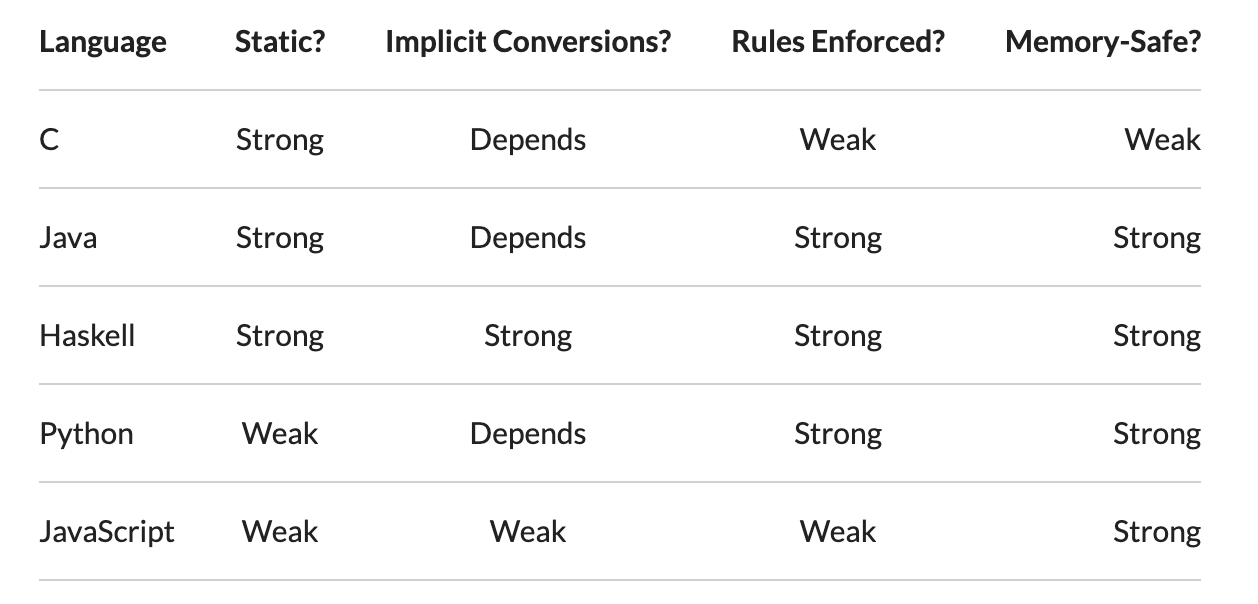
The terms “strong” and “weak” are extremely ambiguous. Here are some ways that the terms are used:
• Sometimes, “strong” means “static”. That’s easy enough, but it’s better to say “static” instead because most of us agree on its definition.
• Sometimes, “strong” means “doesn’t convert between data types implicitly”. For example, JavaScript allows us to say "a" - 1, which we might call “weak typing”. But almost all languages provide some level of implicit conversion, allowing automatic integer-to-float conversion like 1 - 1.1. In practice, most people using “strong” in this way have drawn a line between “acceptable” and “unacceptable” conversions. There is no generally accepted line; they’re all arbitrary and specific to the person’s opinions.
• Sometimes, “strong” means that there’s no way to escape the language’s type rules.
• Sometimes, “strong” means memory-safe. C is a notable example of a memory-unsafe language. If xs is an array of four numbers, C will happily allow code that does xs[5] or xs[1000], giving whatever value happens to be in the memory addresses after those used to store xs. (View Highlight)
When compiling statically typed code, syntax is checked first, as in any compiler. Types are checked second. This means that a static language will sometimes give us one syntax error, but fixing that error leads to 100 type errors. Fixing the syntax error didn’t create those 100 type errors; the compiler was just unable to check the types until the syntax was fixed. (View Highlight)
An entry of “Depends” in the “Implicit Conversions” column means that the strong/weak distinction depends on which conversions we consider acceptable. (View Highlight)