The product leader’s job, says Gibson, is to Delight customers in Hard to copy, Margin-enhancing ways. This approach is known as the DHM model. It essentially means that you want to help your company make more money so you can invest in building an even better product in the future. (View Highlight)
Product leaders must walk the line between delighting customers and making a positive impact on margins. As Gibson puts it, “Netflix customers might say, ‘Just charge me half the money. That would be delightful!’ But that’s not going to support enough profit to make the product better.” (View Highlight)
When Netflix surveys customers about how to improve the service, one of the top answers is shortening the amount of time it takes to get new releases. Due to high demand, most customers have to wait several weeks (or more) to get the new releases at the top of their queues. (View Highlight)
Note: When Netflix used to rent DVDs
This seemed like a promising opportunity for delighting customers, but it was unclear whether it would enhance margins, so Netflix set up a test. They created a group of 10,000 customers who would get a “perfect new release” experience. Any new release they requested would be put in the mail to them the next day. (View Highlight)
The big question they were trying to answer was: Will retention improve as a result? Would the enhanced experience be a big enough change to prevent customers from canceling their subscriptions? (View Highlight)
The answer was… yes. There was a slight dip in the number of customers who canceled. Cancels went from 4.5% in the control group to 4.45% in the test group. Netflix calculated that if they rolled this change out to all 1 million customers, it would prevent 5,000 customers from churning. “Saving” these 5,000 customers was worth 1milliontothecompany.Theycalculatedthisnumberbasedonthenumberofcustomers(5,000)xlifetimevalueofcustomer(100) x word of mouth factor (2). (View Highlight)
But, in order to acquire the inventory that would allow them to roll out the “perfect new release” experience at scale, it would cost the company $5 million. While this enhanced experience might delight customers, it would actually be harmful to the company’s margins. Ultimately, Netflix chose not to roll out the perfect new release experience. (View Highlight)
“Consumer science is really a fancy way of saying ‘the scientific method,’” explains Gibson. You start with a hypothesis, run experiments to collect data, and then analyze the results to come up with a conclusion. (View Highlight)
Flash forward to the present day. Eddie Wu is a Netflix product manager focused on non-members. He noticed that 0.5% of members haven’t used the service in the last 12 months. They’re getting no value out of the service, but continuing to pay for it each month. (View Highlight)
Eddie calculated that auto-canceling these inactive members would lead to a $100 million annual loss, but would the benefits outweigh that? They might, if they focused on the “delight” and “hard-to-copy” parts of the equation. (View Highlight)
Ultimately, Netflix launched this feature, believing that the $100 million loss would be balanced out by the positive impact on their brand. And so far, the bet seems to have paid off. Netflix has gotten positive press and tapped into feelings of goodwill among the general public as a result. (View Highlight)
Gibson says the key takeaways from this case study are that brand is a hard to copy advantage. It was worth “spending” $100 million because it wasn’t really money they had earned. And it was worth it to do the right thing. Plus, it was a low-stakes, reversible decision. They could always flip the switch the other way if necessary. (View Highlight)

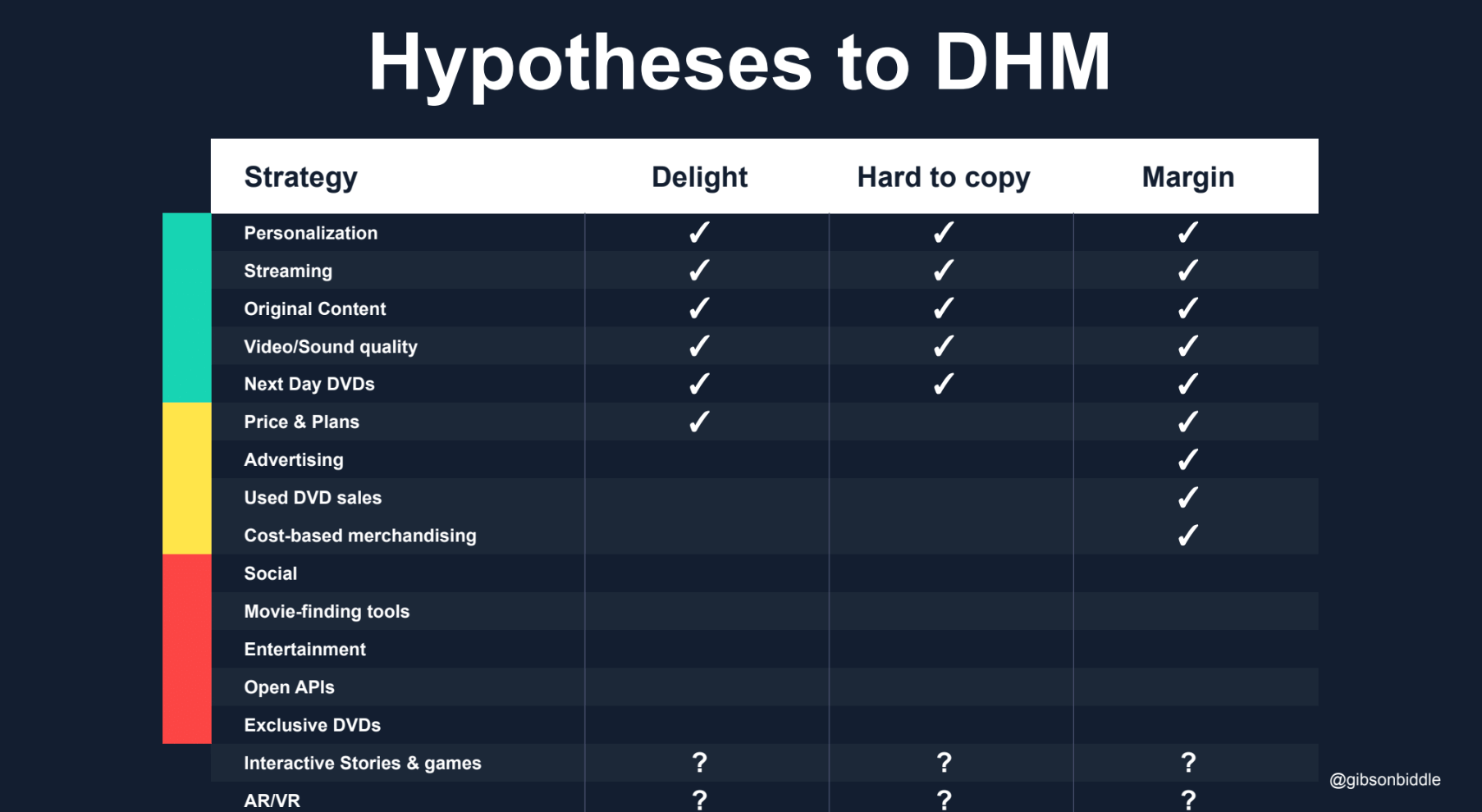 (View Highlight)