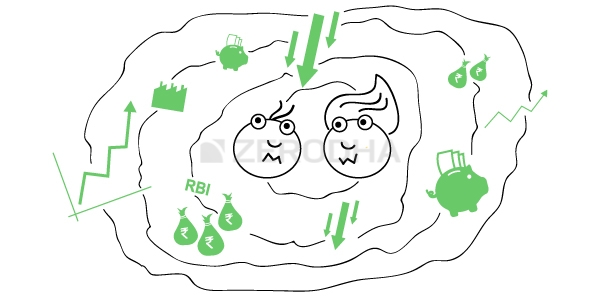
In a nutshell – if the interest rates are high, the borrowing rates are high (particularly for corporations). If corporate can’t borrow easily, they cannot grow. If corporations don’t grow, the economy slows down. (View Highlight)
On the other hand, borrowing becomes easier when the interest rates are low. This translates to more money in the hands of corporations and consumers. With more money, there is increased spending which means the sellers tend to increase the prices of goods and services, leading to inflation. (View Highlight)
Banks can borrow from the RBI. The rate at which RBI lends money to other banks is called the Repo Rate. If the repo rate is high, the cost of borrowing is high, leading to slow economic growth. (View Highlight)
Reverse Repo rate is the rate at which RBI borrows money from banks. Or in other words, Reverse Repo is the deposit rate RBI offers to other banks when the banks park funds with RBI. When banks deposit money to RBI, they are certain that RBI will not default, so the rate RBI offers is relatively low. (View Highlight)
However, the banking system’s money supply reduces when banks deposit money with RBI (at a lower rate) instead of the corporate entity. An increase in the reverse repo rate is not great for the economy as it tightens the money supply (View Highlight)
Cash reserve ratio (CRR) – Every bank must maintain funds with RBI. The amount that they maintain is dependent on the CRR. If CRR increases, more money is sucked out of the mainstream economy, which is not good for the economy. (View Highlight)
The first to react to rate decisions would be interest-rate sensitive stocks across various sectors such as – banks, automobiles, housing finance, real estate, metals, etc. (View Highlight)
Wholesale Price Index (WPI) – The WPI indicates the movement in prices at the wholesale level. It captures the price change when goods are bought and sold wholesale. WPI is an easy and convenient method to calculate inflation. The inflation measured here is at an institutional level and does not necessarily capture the consumer’s inflation. (View Highlight)
Consumer Price Index(CPI)– The CPI, on the other hand, captures the effect of the change in prices at a retail level. As a consumer, CPI inflation is what matters. The calculation of CPI is quite detailed as it involves classifying consumption into various categories and subcategories across urban and rural regions. Each of these categories is made into an index, the final CPI index is a composition of several internal indices. (View Highlight)
A national statistical agency, the Ministry of Statistics and Programme Implementation (MOSPI), publishes the CPI numbers around the 2nd week of every month (View Highlight)
Usually, a low-interest rate tends to increase inflation, and a high-interest rate tends to arrest inflation. (View Highlight)
The Index of Industrial Production (IIP) is a short-term indicator of the country’s industrial sector’s progress. The data is released every month (along with inflation data) by the Ministry of Statistics and Programme Implementation (MOSPI) (View Highlight)
IIP measures the Indian industrial sectors’ production, keeping a fixed reference point. As of today, India uses the reference point of 2004-05. The reference point is also called the base year. (View Highlight)
Roughly about 15 different industries submit their production data to the ministry, which collates the data and releases it as an index number (View Highlight)
If the IIP increases, it indicates a vibrant industrial environment (as the production is going up) and hence a positive sign for the economy and markets. A decreasing IIP indicates a sluggish production environment, hence a negative sign for the economy and markets. (View Highlight)
A lower IIP number puts pressure on the RBI to lower the interest rates and aid industrial credit with cheaper credit. (View Highlight)
The Purchasing managers’ index (PMI) is an economic indicator that tries to capture business activity across the country’s manufacturing and service sectors. This is a survey-based indicator where the respondents – usually the purchasing managers- indicate their business perception change concerning the previous month (View Highlight)
Typical areas covered in the survey include new orders, output, business expectations, and employment. (View Highlight)
The PMI number usually oscillates around 50. A reading above 50 indicates expansion, and below 50 indicates a contraction in the economy. And reading at 50 indicates no change in the economy. (View Highlight)
A Budget is an event during which the Ministry of Finance discusses the country’s finance in detail. The Finance Minister, on behalf of the ministry, makes a budget presentation to the entire country. During the budget, major policy announcements and economic reforms are announced, which impacts various industries across the markets. Therefore the budget plays a vital role in the economy. (View Highlight)
Corporate Earnings Announcement
Corporate earning season is perhaps one of the important events to which the stocks react. The listed companies (trading on the stock exchange) must declare their earnings once every quarter, also called the quarterly earnings numbers (View Highlight)
Besides, some companies give an overview of what to expect from the upcoming quarters. This forecast is called ‘corporate guidance.’ (View Highlight)
Every quarter when the company declares its earnings, the market participants match the earnings with their expectations of how much the company should have earned. The market participant’s expectation is called the ‘street expectation.’ (View Highlight)
The stock price will react positively if the company’s earnings are better than the street expectations. The stock price will react negatively if the actual numbers are lower than the street expectation. (View Highlight)
If the street expectation and actual numbers match, the stock price tends to trade flat with a negative bias more often than not. This is mainly because the company could not give any positive surprises. (View Highlight)
Apart from the events we discussed above, it would be best to watch out for other non-financial events to understand their impact on markets. For example, the Covid crisis of 2020 had a significant effect on economies around the world, disrupting the world economic order. (View Highlight)